Friday, October 29, 2010

Reading Scheduled

A Celebration Of Words:
Kaufmann, Allen To Read From Their Recent Work

Authors Zack Allen and Britt Kaufmann will hold a joint reading of their works at 7pm on November 11 in the Library Annex. All ages are welcome for this free reading of their stories and poetry.

Poet Britt Kaufmann’s chapbook of poetry was recently selected for publication by Finishing Line Press (Georgetown, KY). The collection of poems loosely chronicles her move from the Midwest to the mountains of Western North Carolina and calling a new place home. Included in the chapbook is the poem “These Lost Counties” which was written for and read at the 2008 Carolina Mountains Literary Festival.

Yancey County novelist Charles F. Price praises Kaufmann’s poems: “Transplanted to Southern Appalachia, she turns clear eyes on our abandoned tobacco barns, rock-ribbed heights, hardscrabble farms, tough good people. She sees a simple beauty in our rusticity. Whimsy, warm wisdom, a mother’s love, a good heart’s aspirations all live in these spare yet intricately woven lines; one hears unheard the four-part a capella harmony of her Indiana Sundays even as our mountain seasons turn, our rivers rise, our folk speak their highland talk.”

Kaufmann has lived in Yancey County for the last seven years and has served on the planning committee for the Carolina Mountains Literary Festival for five years. Her poems and prose have been published in Western North Carolina Woman, Now & Then, Main Street Rag, and SouthLit.com among others.

She is currently working on a joint project with local photographer Alicia Jo McMahan to coincide with the release of chapbook in January of 2011. Additionally, she is revising her play An Uncivil Union (based on historical events that occurred in Burnsville curing the Civil War) which the Parkway Playhouse will put on as a part of their 2011 season.

Author of the recently published, Eggtown and Other Stories, Burnsville resident and Asheville native Zack Clark Allen, says he is “way too busy” to be retired. In this collection from his years as a journalist, his stories and poetic insights “capture the flavor and essence of other times and other places; of people and dreams; and of life, as an unfinished poem. “

About his new collection he says, “Some of the stories in this book take place in the rolling hills rising to the south of the Rocky River in northern Anson County, North Carolina. These are memory pieces and reflect on my years with the grandfather whose name I bear. These were simple times that impressed vivid and comforting memories upon the heart of a young boy.

“The other stories are reflections in the waters of the French Broad River, in Western North Carolina, and many were columns appearing on the Sunday editorial pages of the Asheville Citizen-Times.

“One thing became increasingly clear as I looked back at what I had written: a newspaper is not in the business of publishing timeless prose. Writing on deadline makes it the art of the unfinished. So this book is what it must be – a retrospective collection of stories and poems, linked only by vague themes of rivers, currents and passages in my life.”
Allen’s serial careers have taken him on a diverse odyssey. After college, he worked briefly as a chemist in synthetic fiber research before his talent for writing steered him toward a 20-year journey as a writer, editor and columnist. He has published literally hundreds of articles in major newspapers, wire services, and, through syndication, in dozens of other publications around the world. His stories and columns have earned him many awards including being honored as the top columnist in the state for two years in a row by the North Carolina Press Association in the major newspapers category.

He is married to Maggie Lauterer, recently retired pastor of Burnsville First Presbyterian Church, who shares his love of singing ballads and early American shape-note music. He has two daughters, Sydney, and Sarah Addison Allen, who is carrying on the family tradition of writing as the author of three published books: Garden Spells, The Sugar Queen, and The Girl Who Chased the Moon, two of which have appeared on the New York Times Best Seller List. Her fourth book, The Peach Keeper, will be published by Bantam Books next March.


Sunday, October 17, 2010

Frosty Mornings

The last few mornings we've seen light frost silver-gilding the grass, so decided to pick everything we had left in the garden rather than resort to tucking the vegetables in at night under blankets. Lots of hot peppers. Some of those will turn into my husband's bacon-wrapped, cream-cheese-stuffed jalapeƱo poppers. Yum. But I think we're going to try to can some sort of green tomato, pepper relish. Though I haven't found a recipe I like... Many of them ask you to blister and peel the peppers. Not only does that seem tedious, the pain potential seems entirely too high. I'm forever accidentally rubbing my eyes. Before we put any of these plans into effect, though, we need to get a few pair of rubber gloves!

Friday, October 15, 2010

Get yourself to the mountains!

I took this photo from the top of our property last weekend. But in the last week, this same view has turned golden. If you're thinking of visiting WNC to see the leaves, now is the time! I might even suggest a yummy meal in Asheville at The Southern.

Wednesday, October 13, 2010

Why do writers write?

I meant to (re)post this last week, closer to the time it was actually written...

Friend/local writer Alan Gratz blogged last week about why he writes. It's worth reading, especially if you're a writer.

I'm not even close to being in the same position he is... he writes to make a living. Perhaps, if I also had that driving force/need behind my writing, I'd have a few novels under my belt as well. But I don't, and I don't, and so I can slack around doing other things. (Other productive things, though. Like having twins.)

Even before reading his post, the notion of being mindful to what we want to say Yes to had been on my mind. If we can really identify what we want to say yes to, it become easier to say no to the the things that do not align with our yeses. I agree, that if you want to write and publish, you have to say YES to long hours in a chair pecking away at a keyboard. For me, this is not always enjoyable. The rush is when I leave the chair and feel the sense of accomplishment. I felt that last Monday, when I finished a series of revisions on my play An Uncivil Union: The Battle of Burnsville which the Parkway Playhouse will produce next year. The playhouse is submitting it for a grant to help fund production and thus, some revisions were in order. (Though not the last set of revisions, I'm sure.)

I hope the grant board likes it.

Alan's post made me think, since I'm not writing for financial reasons, why am I writing? His observations about wanting an audience certainly rang true. Yes, I want an audience for my thoughts. I think I have something to say--a perspective on life--that more people need to consider. Perhaps this is a product of being an oldest child, a mom, and a former teacher. Perhaps it's plain old arrogance. It is also a fun mental exercise for me to pull from life the odd connections and synchronicities and try to re-represent them in writing so that others can see/feel the same interrelationships. In particular, that's what writing poetry is for me. As my audience as been pretty small thus far, we'll see if I successfully do that or not with the new chapbook. I'll probably never know though.

Anyway -- Thanks for being an audience. I'll try not to be heavy-handed.


Sunday, October 3, 2010

Reading (Binge)

In the last four weeks I have read the following books:
The Blue Star Tony Earley
A Home on the Field Paul Cuadros
The Hunger Games Suzanne Collins
Mennonite in a Little Black Dress Rhoda Janzen
Catching Fire Suzanne Collins
Both Ways Is the Only Way I Want It Maile Meloy
Mockingjay Suzanne Collins
Dragonsbane Barbara Hambly

Now that the weather has turned cold, the time for climbing under a blanket with a book has begun. And of all the odd blessings... I haven't gotten addicted to any new TV shows this fall! Last night, while the ND football game was on, I happily sipped on my first gallon of spiced cider (made in the crock pot with an orange wheel sporting a cinnamon-stick axle and clove tread) and read about dragons, magic, and the plight of a 36 year-old woman caught between dedicating herself to her craft or loving her children and their father. Hmmmm. Though I don't get to turn into a dragon in the end--like she did.

I think a friend's going to lend me The Girl With A Dragon Tatoo too...

Tuesday, September 28, 2010

The Deed Gets Done

Stop right here. This is a friendly warning. I'm posting some pictures of the butchering (my first) at Mike and Lori's from Sunday and a description of what I learned. I have pretty tastefully cropped and blurred the photos so that there isn't any bright-red blood, but there are some up-close ones of me skinning our rooster. Yes, I held it together and was able to participate somewhat.

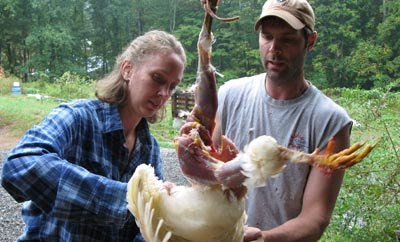
Mike started with one of his own roosters to see how I would do, and while it was slightly alarming, I didn't get woozy or feel the world fogging in on me from the edges. (I've fainted enough to know when it's coming--usually in response to seeing my own blood.) To be as quick and painless about it as possible, he makes two long slits along the neck so that the blood spills out fast and the heart pumps it all out of the body. Of course, the chicken flops around after it's dead -- like we all know they do -- but one of the benefits of hanging them is that they're not running around. That could have gotten to me. (My mother and sister-in-law have horror stories of being chased by headless chickens.) So, when it was time, I got Camillo out of the cage and hung him myself. That's how I got all the feathers stuck to my hand. But I did not slit his throat. I wasn't sure I could do it in a way that would make the process quick and painless.
Then, once all of their roosters had also been butchered and the blood drained out, it was time to skin. Mike and Lori's new fire pit isn't finished yet, so instead of plucking these, he just skinned them. So we'll be using them for soup, not roasting, grilling or smoking. (Actually, we'll be making the roosters into Grandma Carrie's famous chicken-pot-pie!) Anyway. After watching him skin two, I said I was ready to try skinning Camillo. After he started turning them inside out, they really started looking more like "meat" and less like "rooster" -- and I've worked enough with supermarket chicken/turkey carcasses for that to feel familiar, so I was pretty sure I could do it. Mike got the legs started, which is tricky, but once he got that done and the entrails out, it was my turn.
That leg sticking out did hit me in the face a few times as I was trying to get my hands in the right position. Annoying. (In the background you can see their extensive gardens which supply us with a vast majority of our vegetables since we get a CSA box from them - MiLo Acres - every week.)
Here Mike is telling me that when I pull down on the skin, I'm supposed to cut at the point of greatest tension and keep working my way around, pulling down. My doctor husband pointed out that I have my knife at the wrong angle for cutting fascia (the connective tissue that surrounds muscles). You're supposed to hold the knife at a 90 degree angle to the muscle and just saw lightly back and forth. I altered my technique and of course, it worked much better. (I tried not to think about the fact that he knows this not from butchering chickens but from cutting humans! In medical school/residency, in surgery, of course. But still. Ugh.)

Or maybe that's Mike pointing out the wing joint that I had to sever. I had a tough time with it, but I got it eventually.
Next time, my challenge to myself will be to reach in and pull out the entrails. Actually slitting a throat may have to wait for the third time--or fourth. Who knows. We left the necks on, since they make for great soup meat. Then once they were rinsed off, we took 'em home to chill. (Mike and Lori graciously cleaned up.) Right now we have three birds tenderizing in the refrigerator. I also learned it's best to let them sit in the fridge a few days before freezing them or cooking them. Who knew?

Also interesting to note in this process, though I don't have a picture of it, was the color difference between our bird and the others. It could have been just a difference in breeds or ages, but my husband suspected it had to do with quick-twitch muscles. Our rooster got to free-range through the yard (and subsequently had to outrun the dog) so had developed his leg muscles more than Mike and Lori's who have a large outdoor pen, but don't actually free-range. I can look in the pan with the three birds, and easily pick out Camillo's purpler legs. Odd.

In hindsight, I'm glad I did this, and am proud of myself that I saw it through. If push came to shove, I've proven to myself I could provide for my family some of our meat-eating habits. I could raise and butcher chickens should the world collapse around me.

I was able to eat food that night and have not sworn off meat by any stretch of the imagination. We do buy nearly all of our meat from local farmers and are making a concerted effort to avoid supporting large, cruel farms with our purchase dollars. However, homesteading is not something I'm ready to commit to 100%. I have, however, offered to come and help with other butcherings in the future -- if for no other reason, so I can learn how to pluck.

Sunday, September 26, 2010

Tomorrow


Monday marks the first official advance-sales date for my chapbook Belonging. I know I've already put up my website page, made an "event" on FB, and the postcards sent by Finishing Line Press have begun arriving in mailboxes. (And now I've blogged about it.) However, if you think that having seen one of these things makes you exempt from harassing phone calls -- well, you're right. I'm not going to call you. There is a good chance, though, that if your email address is in my gmail account, you'll be getting a friendly email from me sometime in the next six weeks! You have that to look forward to.

Here's my new website page about the chapbook. (With printable ordering form.)

Here's the website for Finishing Line Press and their Advance Sales Page. They also have an Amazon Store where you can buy their older titles.

The toughest part is doing all this publicity work now and having to wait until January to actually hold the finished product in my hand. That is a day I'm really looking forward to.

Saturday, September 25, 2010

The Life of a Carnivore


Back when we got the chicks we'd said We're only keeping one rooster even if it turns out that we've got more than one male.

Now what we were going to do with other males remained to be seen. We knew enough about roosters to know that having more than one would lead to fights, stress out the hens (perhaps hampering their laying), and serious increase the noise level.

Evidently, projecting that they were all girls, and thus labeling them with superimposed graphics, doesn't influence their genetic makeup.

Fortunately, of the 10 chicks we got, only two of them ended up being roosters. And they got named: Camillo & Grey Legs. (Mistake #1. But seriously, how do you talk about a think without having something to refer to it by?) So, that meant it really was a cockfight... fighting to the death... but a fight of a rather different nature.

Barbara Kingsolver, in her book Animal, Vegetable, Miracle helped us (as painful as it was for the kids) to determine qualities to look for: First, which crow is more pleasing to the ear? Grey Legs wins that one with a clear-throated sound that is not raspy and harsh -- as Camillo's is. Second, which rooster protects the hens? In several instances, like when our part-Lab (part-border-collie) dog chased the hens, Grey Legs would take off after the dog while Camillo idly watched the commotion from a safe distance.

On a side note about the dog: It's pretty amazing that while the chickens are in the yard, the dog is content to leave the birds alone. (The border-collie nature wins.) She has even, on occasion, calmly herded them out of the front yard and into the back/side yard where we'd prefer them to stay. But all that's when they're on the mown grass. In the event that one of the chickens should squawk while in the tall boggy area of our drained pond, her Lab genetics take over and nothing, not the children wailing, me yelling, or lightning, can keep her from chasing them--bounding through the tall grasses, floppy ears perked... lookin' for the bird, lookin' for the bird, I was born to find the bird...
See! Evidence I didn't know I had.
There's the white rooster, Camillo, trying to outrun the hens.

Back to the roosters.
Third, is the rooster kind? "Kind?" you're thinking. "How would you even begin to determine if a rooster is kind?" Well, spend some time watching chickens -- which is a lot of fun -- and you'll soon see. Camillo always pushed his way to the front to eat scratch out of our hands. Grey Legs waited and let the ladies eat first. Neither one of them attacked us -- so that's good. But I have, several times, seen Grey Legs pull a worm or grub from the ground and give it to one of the hens. Kindness.

You're getting the picture: Camillo's getting the axe. Tomorrow, in fact. But here's the thing: We can't just kill him & leave him for the foxes & coyotes. We've never been hunters and have never butchered before. Shoot. I've never even gutted a fish. So how do we even do the thing that's most responsible?

Fortunately, we have friends. Friends who, on our request, are inviting us over when they butcher their chickens and will teach me/us. I'm determined to be responsibly involved in process... the whole process of being a carnivore: raising the animal, protecting it from predators, feeding it, killing it, preparing it, and eating it.

I keep telling my kids (who are still refusing to eat the bird) that this is the trade we're making: We gave Camillo a healthy, happy life. In return, he will make our lives healthier and happier. It is a partnership. It is a reasonable trade and we will not be wasteful of his life. We will prepare the meat and make stock from the bones... if there are scraps on our plate, we will give them to the dog. We will use everything he give to us. (Or that we take from him -- however you want to look at it.)

I think this is a very valuable lesson for me to appreciate the amount of meat I've eaten in my life. It is sobering to think of how flippantly I treat the life of a agri-buisness caged-for-short-life chicken that ended up a gross Burger King chicken tender. I am woefully overdue for this dose of reality/responsibility.

Tomorrow, I may be woefully ill. But maybe I need to be. And I'm determined to do this. I'm even leaving the camera in my husband's hands to document how green I turn in this effort to be greener.

Monday, September 20, 2010

Loafing Under Trees

In his novel Middlesex, Jeffry Eugenides' narrator recounts the story of Princess Si Ling-Chi, who discovered the silk worm's thread when she was sitting under a tree and a cocoon fell into her cup of tea and unraveled. He writes, "Great discovery, whether of silk or gravity, are always windfalls. they happen to people loafing under trees."
So I resolve to do more loafing under trees.

Traveling a few weeks ago, I heard on NPR a report about how all our "screens" (smart phones, computers, televisions, ipods, etc.) are distracting us. They keep us from boredom, yes, but they prevent us from rest--the time we need to process and cement into our memory what we've learned. Checking our screens is the worst kind of recipe for addiction-making behavior: intermittent reinforcement. Constant checking prevents us from coming up with new ideas -- it inhibits our creativity -- even though the devices we are checking have the ability to greatly increase our production.
So I resolve to do more loafing under trees.

On the next program, Diane Rheem had on a man whose research showed the connection between our body and mind and how that affects our health. People with chronic pain treated themselves, by employing a relaxing technique and remembering back to a time in their lives when they were without pain to remember themselves back into wellness. He said in times of stress we need to break the cycle of our thought patterns, relax, and think of something else. He cited "believers" -- believers of anything -- being a healthier population than non-believers. The pattern of prayer takes us out of our routine, making us more relaxed, more healthy. One caller shared how in times of daily, routine stress, she stopped and recited poetry...
So I resolve to do more loafing under trees.

Summer is waning and soon the leaves will change... the weather will grow cold..
I believe I have someplace better to be right now.

Wednesday, September 15, 2010

Carolina Mountains Literary Festival

What a great weekend it was. I don't think I've ever learned so much in a festival weekend:
  • trivia facts: the quartz used in the Hale Telescope came from Mitchell county, Plott Hounds were a breed originated in Western North Carolina (I probably should have known that one, but I didn't grow up here), the 1904 Word's Fair had some 500 acres of land designated to "house" "indigenous peoples" from around the world and the Smithsonian arranged to have the rights to their bodies should they die during the fair.
  • new ways of thinking about writing poetry: the use of subordinating clauses to take you under surface meaning, abiding images, prose poetry as a means of avoiding the pretentious pause when reading line breaks, writing simply for the sound of the words, finding the plainest image to communicate meaning instead of the most abstruse one.
I also began to understand how each writer's process is different, needs to be, and the task is not necessarily to emulate a great writer's process, it is to discover your own. Stick with what works for you to be productive. Here are some processes writers described:
  • Long periods of self-loathing followed by furious bouts of typing. (hahaha!)
  • Starting poetry in the subconscious with #1 an "abiding image," #2 writing a big mess around that image, then in the conscious mind #3 attending to craft and paring it down.
  • One said, "Writing a novel is like putting hundreds of marbles on a table that's not quite level. And the moment I get them all to hold still I say -- I'm done. Because I know if I move just one thing, it'll all fall apart."
  • One has stopped journaling because it prevents her from writing anything else that day.
  • One calls it "canabalizing" (plagiarizing?) his own work as he takes the same images, words, and uses them in fiction, poetry, essay...
  • Some take copious notes and jot down things, some hold it all in their minds.
I was also very moved when Paul Cuadros was able to address 60 middle school students and probably 60 high school students... (there were about 240 in the room) about issues of immigration in small rural communities. His book A Home on the Field is very relevant and a worthwhile read -- especially if you like soccer. I would recommend it to you all.

And if you don't believe me that it was a great weekend, check out what an unbiased participant had to say: Robin's Blog.